Search This Blog

Sunday, October 28, 2012

Evil and Innocence Dwell Within The Human Heart - Del Toro's View of The World

SPOILER ALERT: This entry is filled with spoilers of Cronos, Devil's Backbone and Pan's Labyrinth.

Guillermo del Toro is an extraordinary film-maker. He has given a new dimension to horror/fantasy genre. Films like Pan's Labyrinth and Hell Boy have not only been hailed by the critics, but have been immensely popular with the general public as well. Del Toro's genius lies in the fact that in this era of torture porn when extreme violence and gore is equated with horror, he knows that true horror comes not from the supernatural, but from humans. Also, only human's have the true power to counter the evil. His movies have a strong, beating heart which makes the audience truly care for the characters and their fate. That, to me, is one of the acid tests for a good film. When I start to care about the characters, I know that it's a good film.

A very interesting thing about his films is that inspite of being a horror/fantasy film, the duality of good-evil doesn't rest with the supernatural elements. Human beings are the evil ones and the supernatural elements are almost always rather benign. Also, the force of good is represented by human characters. Before I go any further, let me mention the films I am considering here. I am talking about Cronos, Devil's Backbone and Pan's Labyrinth. Am not counting Hell Boy here as it's a comic book adaptation and thus the story is not his own. I have not seen any of his other films.

Another strong element in these films is the power of innocence, specifically the innocence of children. We often see things through the eyes of the child and thus, we are forced to adopt the same black & white outlook towards the world. We see things not as cynics but rather with wonder. We believe in the power of good and know that good would triumph in the end, no matter how hopeless it looks. As children, we are forced to confront the adult notions we have built about supernatural and question what we fear. It's not the vampire in Cronos whom we should be afraid of, he is our loveable grandfather! The scary ghost in Devil's Backbone is only a helpless child, crying out to people to help him. The fearsome looking faun in Pan's Labyrinth is really a friend, trying to help us reach our goal.

The evil comes from politics and power. Men with too much power and the endless lust for more create horrors beyond any that a supernatural can dream of! The fight ultimately lies between humans, with the supernatural playing the part of a benign force, helping good. War, especially the Spanish civil war seems to be something Del Toro strongly associates evil with. Both Devil's Backbone and Pan's Labyrinth are set around it.

Finally, the end in these films are always tragic but hopeful. This is consistent with the viewpoint of a child, which we assume while watching these films. Inspite of the great tragedies that happen in the end of these 3 films, there is always a ray of hope. The vampire in Cronos is able to rest with his granddaughter, who loves him. The girl in Pan's Labyrinth finds her magic kingdom where she is the princess, even though in this world she is actually dead. Even after the death of so many innocent characters in Devil's Backbone, the remaining orphans make their way out to the town, while the ghost of the doctor watches them from the orphanage with the gun in his hand, ready to protect the children if need be.

Sunday, July 22, 2012

God Particle, Conscious Universe & Leaps of Reason


Another non-film article.


A leading daily publishes a weekly spiritual section. Needless to say I rarely read it. But today there was an article on the famous "God Particle". It was written by 3 people. 2 of them are scientists at prominent US universities and the other is a spiritual-inspirational speaker.

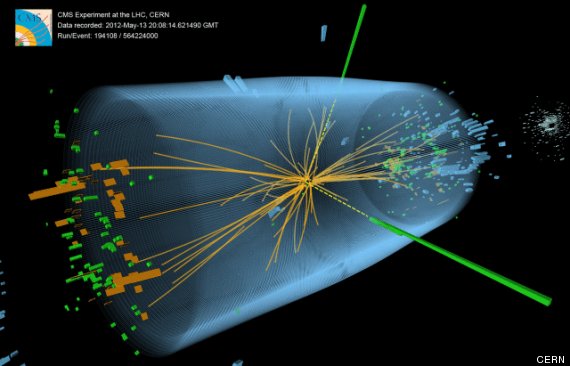
The name, God Particle, originally intended as an illustration of its illusive nature, soon became a media darling. I simply call it by its true name, Higgs Boson. Once the name stuck, there were inevitable religious and spiritual connections being drawn to the poor particle. Not surprising really. Religion detests science and scientific methods. Ask a religious person to provide evidence or scientific rationale for his/her god and they would say it's a matter of faith. But, if there is ever the slightest hint of any supernatural phenomenon in the natural world, the religious are the first to become scientists and parade that as evidence for god. Case in point being the infinite images of Virgin Mary and Jesus in a tree trunk, the holy word of Kuran in  cloud formation and the idols of Ganesha drinking milk! Religion picks stuff from science they are comfortable with and denounce the other things which question their faith. So, once the world knew that physicists are looking for something called the "God Particle" and that it is somehow essential to the theories of physics (Most of them had no clue what the theory was and what was the role of Higgs Boson in it), the media started taking interest in it. May be too much interest. The media frenzy we have seen recently over the discovery of Higgs like particle is inspiring, but too many of them were focusing on the God part and not the Particle part.

The article in question did not dwell too much on the science behind the Higgs Boson. Rather, it went on to make some interesting conjectures about the implications of the discovery on science and spirituality. There is no doubt that the discovery is one of the monumental achievements of physics in the last few decades. This gives us a solid ground to build upon. Being more or less sure of the Standard Model, we can now build upon it without the nagging fear of it all crumbling down. Yes, there is always the chance that there would be some flaw in the model and not all the work based upon it would be fruitful. Infact, it is almost inevitable that there would be parts of the theory which would not be universally true. Most of the theories of physics hold true only under specific conditions.

The article, however, went on to point out that the quantum model of the universe has destroyed the solid, classical model and then it made a leap of reason I didn't quite follow. From the quantum model, it went on to talk about the 'obvious' indication for the existence of a universal intelligence. To quote the article, "The Universe evolves, regulates itself, takes creative leaps and exhibits exquisite mathematical rigour and beauty. The hallmarks of intelligence are there, waiting for the next paradigm shift." The article then goes on to say that the word 'intelligence' is tricky in this day because it implies intelligent design. So, to avoid it they called it Consciousness. They are suggesting a Conscious Universe instead of an intelligent one. Bravo!

I agree with most of the sentence, except for 2 parts. One, I don't see any evidence for the universe taking 'Creative Leaps' and second, I don't see the hallmarks of any intelligence. If anything, the statement indicates strongly that there is no intelligence or consciousness dictating the universe. Let us evaluate the points mentioned in the sentence.

It first talks about an evolving universe. That is the surest sign of the absence of a creator/moderator. Evolution is a gradual, slow and uneconomical process. If I was to create a watch (theists love the watch), I will make the watch as perfect as I can. And if I am the omnipotent God, then I would surely make a perfect watch. I will not spend millions of years, making millions of models, each model only a little different (different, not always better) from the previous and 99% of the models so bad that they broke down. That is how evolution works. Why would an intelligent or conscious designer make something with so many trials and errors! His success ratio is worse than the dumbest kid in the school!
The next point in the article is a self regulatory universe. Well, that practically says that there is no need of a God. Self regulation of the universe comes from the laws of nature. The laws themselves are intrinsic parts of the mater and energy that form the universe. If the laws were any different, the universe wouldn't exist in the form it does now. So, there is no need for a God to regulate or create the universe. The natural order of things take care of itself. Once Laplace was explaining the celestial model to Napoleon. When he had finished explaining the things, the great emperor asked Laplace, where was God in his theory. Laplace replied, "I have no need for that hypothesis in the model".

As for taking creative leaps, I see no evidence for that. The universe takes no leaps at all. Things happen gradually and according to the laws of nature. A creative leap would be if one fine morning we wake up to find a new planet in the solar system or a new, totally unique species of animal roaming the earth. That would be a creative leap. Instead, what we see around us is the result of slow and gradual evolution of things, whether celestial or life form. The Universe does not take any creative leaps at all.

Finally, it talks again of the rigorous mathematical laws followed by the universe, which only proves that the universe follows mathematical patterns. It does not imply any divine, intelligent or conscious presence in any way.

The leaps of reason taken in that article were quite huge. They are all prominent scientists, so it's quite possible that I was not able to follow their leaps of reason. But it was written for the general public. Shouldn't they have explained the things more clearly, if they did have any rational link? How do you arrive from the quantum theory to a conscious universe? To me, there is no link.

Wednesday, September 21, 2011

Regarding a Misogynist

Lars von Trier is perhaps the most controversial director of our times. His films have been banned by countries, panned by critics, booed upon at Cannes. He has been called a sadist, a masochist, a depressed maniac and a misogynist. His latest debacle at Cannes 2011 has earned him the wrath of the festival organizers and resulted in his ban from the festival itself. A simple search of the net would get one innumerable articles describing what a horrible person he is. But, one thing that even his worst critics accept is that he is a bold film-maker.

I don't use the term 'bold' here in the sense that many of our actresses use it for, although his films often show unsimulated sex as well. By bold, I refer to the themes he explores and the techniques he uses to present them. I am a great admirer of his films. I don't know what kind of a person he is, but he certainly is not a misogynistic film maker. He is one of the very few male directors who has made multiple films with a powerful female lead. I have not seen all of his films, but of those which I have seen, 4 films have female leads who have more powerful roles than the male. Let me make my case with two of those four films, briefly here.

Breaking the Waves

The story here is as unusual as the presentation, which is almost a norm for von Trier. It tells the story of a 'simple minded' Scottish woman and her unwavering love for a man. The woman, Bess, played by Emily Watson, is somewhat mentally challenged. She falls in love with a man, Jan, played by Stellan Skarsgård, who seems to love her just as devotedly. They get married and soon, tragedy strikes. In an accident, Jan injures his spinal cord and is paralyzed. Bess believes this to be her fault, as Jan was away at an oil rig when the accident happened and Bess was praying for him to return soon. She sees this as god's punishment to her for being selfish. Ridden with guilt, she asks Jan to forgive her. Now this is where the film becomes twisted. Jan realizes that he would probably never be able to move much again and he asks Bess to have sex with strangers and tell him about her encounters. Bess gives in to his wishes and starts having sporadic sexual encounters with various people. This includes her advances to Jan's doctor, who turns her down and gradually seems to fall in love with her. She even starts to believe that this would somehow help Jan to recover quicker. She is shunned by the community and Jan seems to be the only one who is blind to the hurt this is causing her. In the end, she goes to a boat where she is brutally raped and she dies of the injuries.

The whole film is shot with hand-held cameras and is partially a Dogme 95 film. Extreme simplicity in presentation is maintained throughout.

It's easy to see why many consider this to be a rather misogynistic topic. But when watching it, I kept wondering, is it possible that Jan's motive in asking Bess to do this was not entirely sadistic, but rather a misguided attempt to do some good? I think that when Jan realized he is going to be paralyzed for the rest of his life, he decided that Bess should move on. Knowing Bess's blind devotion to him, it would have been impossible to convince her to leave his bedside. So, Jan devised this plan with the hope that she would meet someone special, who would truly love her. And she does. The doctor loves Bess as earnestly as possible. Only Bess is too focused on healing Jan (or so she believes) to find time to love him back.

I know that my interpretation is not the only one, or perhaps not even the most popular one. But any way I look at it, Breaking the Waves is not a misogynistic film as it actually shows the simplicity of the woman.

Dancer in the Dark


Now this is a film that can not possibly be interpreted as misogynistic, no matter what! It's the story of a young woman immigrant in USA who works in a factory. She works hard and her life revolves around her son. We learn that the woman, played by the singer Björk, has an eye disease which is slowly leading her to blindness. The tragedy of the tale is that her son has also got the disease and unless treated soon, would go blind in time, just like her.


This is a hardcore melodrama, but presented with such shocking honesty that one can't help but get sucked into the film. The style is again very Dogme 95 and minimalist. The songs are shot like a typical 'movie' shoots as against the 'home video' feel of the rest of the film. This makes them serve the same purpose that sentences in parentheses do in a prose. The desperation of the woman and her helplessness at realizing how crooked the world really is, strikes the viewer like a sledge hammer. The end of the film is one of the most disturbing shots I have seen. Gets me every time.


The other two films I have seen with incredibly power female leads are Dogville with Nicole Kidman in the lead and Antichrist with Charlotte Gainsbourg. Dogville is perhaps the most radically shot film I have seen, with an almost empty sound stage as the set of the small town. Antichrist is arguably the most misogynistic of all of his films, but even in that, what he really shows is the evil within all human beings, not just women. Also, from what I have heard, Melancholia has two female leads, so that raises the count to 5!


I didn't write this piece to show my support for von Trier. He doesn't need that. I wrote it to merely present my views on his films. I love his films and frankly, I don't care what kind of a person he is. Like they say, art and artist are two separate entities and must be treated so!

Saturday, June 18, 2011

Meeting My Favourite Literary Character

I know this is really a high-school essay topic, but since my teachers never asked us to write this, I am going to write it now!

The 1st character I thought of was Sherlock Holmes, ofcourse. But then, after thinking for a while, I realized I really want to write about Morpheus! Here it is!


MEETING MY FAVOURITE LITERARY CHARACTER

I have been travelling around the countryside for days now. Even though it’s only a short vacation, it feels like I have been here forever. The rustic beauty of the village, the serene lake, the majestic mountains bordering the village and the never ending woods just outside the village temple. All feel like a part of me. Like I have been here forever.

It was a bright winter morning and I had gone exploring the woods. Every step I took was like a new wonder, placed there especially for me! I was walking with one eye on the narrow road, hidden beneath the fallen leaves and twigs and another eye on the camera’s viewfinder. Click, click, click…

At a distance, I see a man standing, with his chin on his chest, lost in his own world. The man is tall and wearing a black overcoat. I hesitate for a moment, wondering who he is and what’s he doing here. His dress is not that of a villager, so he must be a tourist like me. Should I go talk to him or just let him be? But isn’t a trip like this supposed to be a ‘human’ experience as well? Atleast that’s what all the books say.

“Hi there!”, I approach him and  wish I was a little taller. He is so tall!

“Hello.”

“Nice morning for a hike!” I try to sound like I have not noticed his pale skin. It isn’t polite to stare at a person’s unusual appearance, you know.

“Yes, I think I like it”

“The villagers were telling me there is an abandoned church somewhere in the woods. Do you have any idea where it might be?”

“I don’t think it’s really the church you are looking for, although I do know where it is.”

“Umm… I am pretty sure that I want to see the church. It should be interesting. What makes you think I don’t want to see it?” What a presumptuous prick! I think to myself. I notice that his flowing black overcoat is a little old fashioned, not that I am very fashionable. The blackness of the coat seems to be a strange effect. Like he is wearing the night itself!

“I never said you don’t want to see the church. I said it’s not really what you are looking for. It’s not the reason you are here today.”

“Well, I accept that I really came here to experience the natural beauty of the woods rather than the church. But now that I am here, I think I would check out the church too. Don’t you think it’s a good idea?”

“It’s not easy to reach this place.” He says, as if he didn’t even hear me. “The fact that you are standing here with me means that there is something within you which is significant enough to be placed here! But, before that is done, you must acknowledge it to yourself! You must face the truth and discover what you are here for! You don’t get second chances here.”

Goddamned travel books! I was better off just roaming around on my own and clicking pictures! Bloody human experience! Gets me talking to a nutcase! “Umm… Sorry about the confusion. I think I know which way to go. Thanks for your, umm… help!”

Run… run your ass off before the guy comes chasing after you with a shovel! Thank goodness he isn’t really chasing me. He is just standing there, looking at me. There is something wrong with his eyes too. Hadn’t noticed them earlier. They are hardly like normal eyes. They are like pools of black night with a star shinning in each eye! What’s wrong with that man?

Do I hear a bell ringing? Can it possibly be the church bells of the abandoned church? I follow the sound of the bells and Surprise! It is the church indeed! A couple of pure white angels are ringing the bell. Well, it must be a Sunday. The mass is quite impressive for an abandoned church. Lots of fauns and sphinxes here, I see.
And then I realize what I gave up in the woods! He said I won’t get a second chance here! Noooo…

Sunday, July 25, 2010

Alfred Hitchcock and the Restrictive Movement Style

He is one of the masters of film making and is often noted as one of the greatest and most influential directors of all times. The unrivalled master of suspense thrillers who made an art out of murder. The important thing about his films is that more than the plot, it was the style of presenting the story that made it so exciting.

Hitchcock was also not afraid of experimenting. Needless to say, most of his experiments turned out to be successful! In the recent past, I chanced upon a few of Hitchcock films and I was surprised to find a good many of them following a very peculiar setting. Something I call, restrictive movement. He didn’t allow his characters a lot of room to move about. So, the story is set in a place and all the action takes place at the spot. This, in my opinion, is a brilliant devise to increase the tension. You know that you can’t run. You can’t escape. The viewer constantly feels claustrophobic. Ofcourse, it’s no walk in the park to make a film like that. There are numerous difficulties in shooting a film in such a small space. But, Hitchcock’s genius lies in the fact that he actually uses some of those challenges to his advantage! Let’s take some examples of his films which use restrictive movement.

Of the films that I have seen, Rear Window, Rope, Lifeboat, Dial M for Murder and The Lady Vanishes uses this style of film making. The last two, although are not strictly restrictive.
Allow me to get into some of the details of these films and see how restrictive movement film-making makes the movies so special.


Take the case of Rear Window. This is the story of a photographer who has broken his leg and is grounded for a few days. So, the bored guy takes into looking out of his apartment window into the neighbourhood. Trouble begins when he suspects one of the neighbours to have murdered his wife. The whole film is set in the small apartment of the protagonist. Everything in the film is seen from within the apartment. This has the obvious disadvantage that it restricts the viewer to the line of sight from inside the apartment. But, here Hitchcock uses this very problem to make it even more thrilling. We see the man leave the building, but we don’t see if he took a cab or not. We don’t see how far he walked in the rain that night. We don’t see him approaching the protagonist’s room, just hear the footsteps! When he enters the room, the protagonist’s wounded leg makes him vulnerable to attack and we wonder will he be able to make it! Rear Window would have been a pretty average film, if only it was made in a usual way. The story is nothing that great. It’s the tension created by the restrictive movement that makes the film special.


Rope is one of the most innovative films I have ever seen. Here, Hitchcock attempts two unusual styles. First, it’s all set in one house, so it’s restrictive. Second, it appears to have no cuts at all! That’s one hell of an experiment. The whole film is like a theatre play with no cuts at all. Well, actually it has cuts. Those days a film roll couldn’t shoot for more than 10 minutes. So, Hitchcock too shots as long as he could and then mask the cuts. For example, he would zoom the camera into a man’s coat until it blocks the screen and use the black screen to mask the cut. This is a very risky experiment, especially for a thriller. It’s an established fact that shorter scenes increase the pace of a film and long takes tend to make the film slow. So, long takes are often used in drama where the characters get time to establish the setting. For a thriller, it is important to keep the film fast, so that the audience is on the edge. Hitchcock used extreme long takes, but makes the action fast in the film, thus ensuring that the tension is maintained. The story is about two friends who kill another friend just to see if they can get away with it. To top it all, they arrange for a party in their home with the body hidden in a chest, right in the middle of the room. It’s a great story and the setting makes it all so special. This is perhaps one of the few films where restrictive movement wasn’t that challenging. The story was set entirely inside the house, so we didn’t need to know what’s going on outside. This, in fact, increases the focus of the film and we have no distractions


Lifeboat is another master-piece! This is a war era film. An allied ship is destroyed by a German U-boat and the survivors get on a lifeboat. Before being sunk, the ship managed to destroy the U-boat too and the lifeboat picks up one of the German soldiers too. The whole film is set in the lifeboat, in the middle of the ocean! The tension begins from the 1st moment, when we wonder when will they be rescued. Things are complicated by the fact that none of the ‘good guys’ really seem to know their way around the ocean. The only man who claims to know the way is the German, but can we trust him? Our sympathies keep oscillating between the characters like a foucault pendulum and we are never sure what’s happening. This film obviously had to be restrictive in its movement. The feeling of being totally lost and helpless is brilliantly used by the director. He pulls us into the lifeboat as well!

Dial M for Murder and The Lady Vanishes are not strictly restrictive. There are a few scenes which take place in other locations as well.


Dial M for Murder tells the story of a man who plans to get his wife killed by another man. The story unfolds almost entirely in the couple’s house. There are a few shots outside as well, but most of it is inside. There is a beautiful shot in this film when the cop watches the man enter the gate and fall into his trap, all through the window in the room.


The Lady Vanishes has a lot of scene shot in different locations, but even that is restrictive. The film starts at a hotel in a European country and then, after some time, takes place in a moving train. So, inspite of being shot in different locations, most of the action takes place inside the train, which makes it very restrictive indeed. The feeling of being totally trapped without an escape makes the film so thrilling! Ofcourse, Hitchcock shows that it’s not always a bad thing to be trapped in the train. There is a scene when the train proves to be the rescue vehicle!

All these films demonstrate how Hitchcock perfected the art of restrictive movement and really used it to enhance his films, not just in style, but in structure as well! Would be glad for more inputs on this! On other Hitchcock films which follow this style or films by other directors as well! Have fun!